Help Your 1-Year-Old Understand Action Words Through Everyday Play
Action words are words that describe what someone or something is doing. Words such as eat, drink, walk, clap, wash, and sleep are especially useful for young children because they can hear the word while seeing or doing the action at the same time.
For a 1-year-old, action-word learning does not need to look like a lesson. The strongest opportunities usually happen during ordinary routines: eating breakfast, washing hands, opening a box, waving goodbye, or getting ready for sleep.
Start with what your child already enjoys. Model it, play with it, and stop before it becomes a chore.
The goal is simple: help your child begin connecting a spoken word with a familiar action.
Quick Answer: What Are Action Words?
Action words, also called verbs, tell us what someone or something does.
When you say:
- “Eat” while your child takes a bite
- “Drink” while holding a cup
- “Clap” while clapping together
- “Wash” while washing hands
- “Open” while opening a container
…the meaning of the word becomes something your child can see, hear, and experience.
At around 1 year, keep action words connected to real experiences rather than expecting your child to memorize or repeat a list of words.
Action Word Examples for a 1-Year-Old
Begin with actions that your child sees or experiences frequently.
Eat
Say “eat” when food is going toward the mouth.
Try:
“Eat.”
“Let’s eat.”
“You eat banana.”
Drink
Use the word when offering a cup or taking a sip.
Try:
“Drink.”
“Take a drink.”
“Drink water.”
Sleep
Connect the word to bedtime, naps, stuffed animals, or pictures.
Try:
“Sleep.”
“Baby sleeps.”
“Time to sleep.”
Sit
Use it naturally when your child sits in a chair, on the floor, or in the stroller.
Try:
“Sit.”
“Sit down.”
“Bunny sits.”
Stand
Say it as your child or a toy moves into a standing position.
Try:
“Stand.”
“Stand up.”
“Bear stands.”
Walk
Use the word while walking together or moving a toy person.
Try:
“Walk.”
“Let’s walk.”
“Dog walks.”
Run
A child may hear this word before doing much running independently. Toys, siblings, pets, and parents can demonstrate it.
Try:
“Run!”
“Dog runs.”
“Run, run, run!”
Jump
Jump yourself, bounce a toy, or make a stuffed animal jump.
Try:
“Jump!”
“Bunny jumps.”
“Jump up!”
Clap
This is an easy action to turn into a playful imitation game.
Try:
“Clap.”
“Clap hands.”
“Clap, clap, clap!”
Wave
Practice during greetings and goodbyes.
Try:
“Wave.”
“Wave hello.”
“Wave bye-bye.”
Wash
Use the word during handwashing, bath time, or pretend play.
Try:
“Wash.”
“Wash hands.”
“Wash the cup.”
Open
Use containers, doors, books, boxes, and toy cupboards.
Try:
“Open.”
“Open the box.”
“Let’s open it.”
Exact Action Words to Start With
For a 1-year-old, you do not need to introduce all of these at once. Choose a few that appear naturally in your child’s day.
Starter Action Words
eat · drink · sleep · sit · stand · walk · run · jump · clap · wave · wash · open
A useful starting group might be:
eat · drink · clap · wave · open
Once those words become familiar through play and routines, introduce others.
There is no need to quiz your child on the words. Hearing the same simple language during meaningful activities is enough to make the experience useful.
How Action-Word Learning Changes With Age
Children can explore the same action words in different ways as they grow. Rather than treating these as tests or deadlines, use them as ideas for making activities gradually more interesting.
Earliest Stage: Actions + One Word
Keep language extremely simple.
You might clap and say:
“Clap!”
Or open a box and say:
“Open!”
The action gives the word meaning.
Around 1 Year: Word + Familiar Routine
Connect words with things already happening throughout the day.
During lunch:
“Eat.”
At the sink:
“Wash hands.”
At the door:
“Open.”
When leaving:
“Wave bye-bye.”
Your child can participate by watching, touching, moving, pointing, copying, or simply enjoying the activity.
Young Toddler Stage: Word + Simple Phrase
As your child’s understanding grows, action words can become part of short phrases.
For example:
“Baby sleeps.”
“Dog runs.”
“Wash hands.”
“Open box.”
“Bunny jumps.”
Keep the sentence short enough that the important action word remains easy to hear.
Older Toddler Stage: Choose and Act
Turn familiar action words into little games.
You can ask:
“Should the bear sit or jump?”
“Can the bunny walk?”
“Can we clap?”
“Let’s wash the toy.”
The activity becomes more interactive without needing to become a quiz.
Preschool Stage: Actions in Sentences and Stories
Preschoolers can explore action words in longer sentences, pretend play, songs, books, and storytelling.
For example:
“The dog runs to the tree.”
“The girl opens the door.”
“The bear eats an apple and then drinks water.”
“The bunny jumps, walks, and then goes to sleep.”
The same simple words introduced during everyday routines can later become building blocks for longer language.
5-Minute Action Words Activity
Play, Point & Do
Time: About 5 minutes
You need: 2–3 familiar objects connected with simple actions
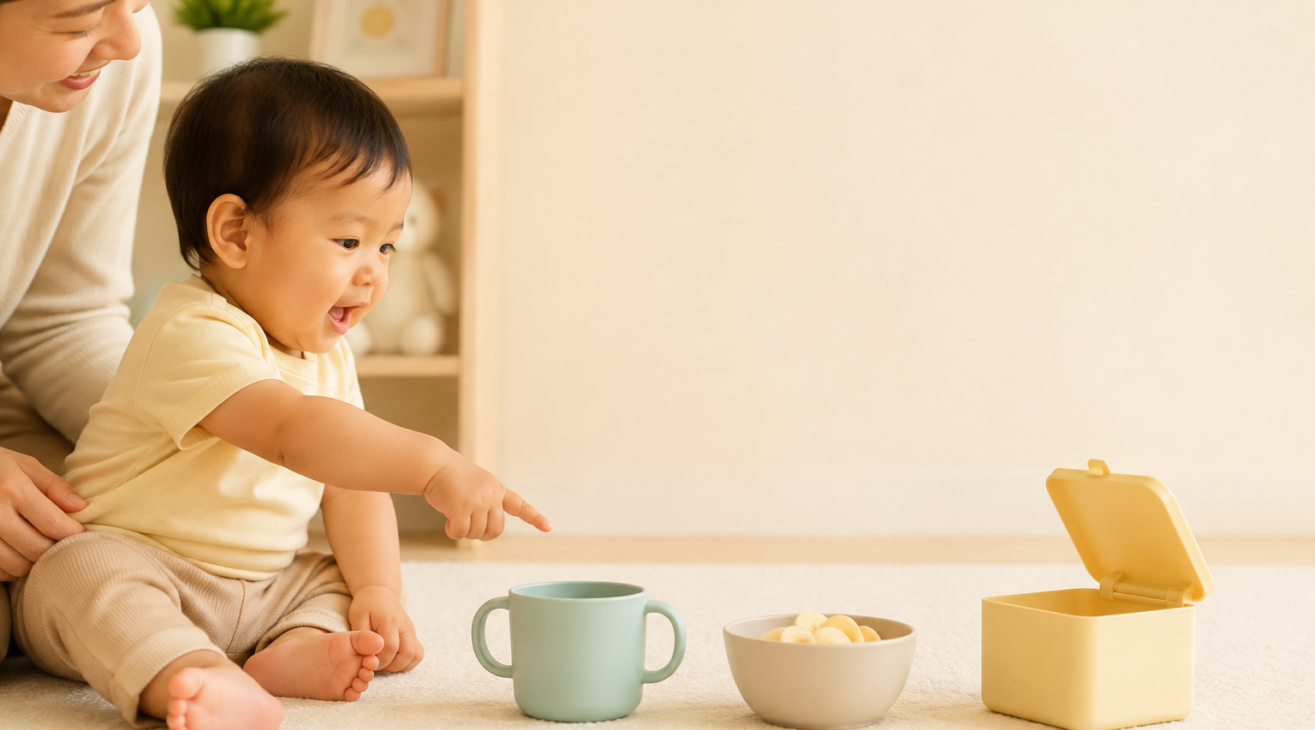
Set out 2–3 familiar objects related to action words. Name each, let the child point/touch/move it, and repeat one short phrase.
For example, use:
- A cup for drink
- A spoon or play food for eat
- A small box with a lid for open
Step 1: Introduce One Object
Hold up the cup.
Say:
“Drink.”
Pause and let your child look at or touch it.
Step 2: Show the Action
Pretend to drink.
Say:
“Drink.”
Then:
“Drink water.”
Step 3: Let Your Child Explore
Offer the cup.
Your child might grab it, point at it, pretend to drink, move it, or simply watch.
All of those can be part of the activity.
Step 4: Repeat
Say the same short phrase a few times during the play.
“Drink.”
“Drink water.”
“Drink.”
Step 5: Move to Another Action
Open the box.
Say:
“Open.”
Close it and open it again.
“Open the box.”
Keep the activity playful and finish while your child is still interested.
Make It Easier
If three objects feel distracting, use one action and one object.
For example:
Take a box.
Open it.
Say:
“Open.”
Close it.
Open it again.
Say:
“Open.”
That’s the whole activity.
You can also skip objects entirely and use body movements:
Clap.
Wave.
Sit.
Stand.
Short, familiar actions make it easier for a young child to notice the connection between the movement and the word.
Turn Everyday Routines Into Action-Word Practice
You do not need special learning time to introduce action words.
Mealtime
Use:
eat · drink · sit · open
Examples:
“Eat banana.”
“Drink water.”
“Sit down.”
“Open it.”
Bath & Handwashing
Use:
wash · sit · stand
Examples:
“Wash hands.”
“Wash feet.”
“Stand up.”
Getting Ready
Use:
sit · stand · walk · open
Examples:
“Sit here.”
“Stand up.”
“Open the door.”
“Let’s walk.”
Playtime
Use:
run · jump · clap · wave · open
Examples:
“Car runs!”
“Bunny jumps!”
“Clap hands!”
“Wave hello!”
“Open the box.”
Bedtime
Use:
sleep · sit · walk
Examples:
“Bear sleeps.”
“Time to sleep.”
“Let’s walk to bed.”
Try This: Action Word Toy Game
Choose a favorite stuffed animal.
Make it perform one action at a time.
The bear can:
sit
Then:
stand
Then:
walk
Then:
jump
Then:
sleep
Narrate each action with one short sentence.
“Bear sits.”
“Bear stands.”
“Bear walks.”
“Bear jumps.”
“Bear sleeps.”
A familiar toy lets children see the meaning of the word without needing complicated instructions.
Action Word Movement Game
Some action words require no materials at all.
Try saying and doing:
Clap!
Clap together.
Wave!
Wave together.
Walk!
Walk across the room.
Jump!
Make a small playful jump or make a toy jump.
Sit!
Sit down.
Then repeat a favorite action.
You can make funny changes too:
“Bear jumps!”
“Daddy jumps!”
“Bunny jumps!”
The repeated verb remains the same while the person or toy changes.
Action Words With Books
Action words are also easy to explore while looking at picture books.
Instead of reading every word on the page, occasionally point out what a character is doing.
You might say:
“The dog runs.”
“Baby eats.”
“The bunny jumps.”
“She sleeps.”
“He opens the door.”
This gives parents an easy way to bring action words into something they may already be doing.
Action Words Printable
Action Words Picture Cards
Create simple cards showing familiar actions such as:
- Eat
- Drink
- Sleep
- Sit
- Stand
- Walk
- Run
- Jump
- Clap
- Wave
- Wash
- Open
Each card can include:
One large picture
One action
One printed word
Parents can choose just 2–3 cards at a time instead of showing the entire set.
Mini Action Words Book
A small printable book could include one action on every page:
I eat.
I drink.
I sit.
I stand.
I walk.
I clap.
I wave.
I sleep.
Parents can point to the picture, say the action, and demonstrate it whenever possible.
Parent Prompt Cards
Another useful printable is a set of quick prompts parents can keep nearby.
For example:
OPEN
Open a box together.
Say:
“Open.”
“Open the box.”
CLAP
Clap together.
Say:
“Clap.”
“Clap hands.”
WASH
Wash hands together.
Say:
“Wash.”
“Wash hands.”
These work particularly well for parents who want ideas without needing to plan a full activity.
What If My Child Doesn’t Want to Join In?
That’s okay for the activity.
You can simply model the word yourself.
If you say:
“Clap!”
and clap your hands, your child can watch.
If you say:
“Open!”
and open the box, your child can watch.
Participation does not need to mean repeating the word or copying every movement.
Young children may watch, touch, move, point, smile, imitate, wander away, or return later.
Keep the experience relaxed.
Start with what your child already enjoys. Model it, play with it, and stop before it becomes a chore.
Next Step: Move From Actions to Tiny Phrases
Once an action word is familiar, keep the word and add one small piece of information.
Instead of only:
“Eat.”
Try:
“Eat banana.”
Instead of:
“Jump.”
Try:
“Bunny jumps.”
Instead of:
“Wash.”
Try:
“Wash hands.”
Instead of:
“Sleep.”
Try:
“Baby sleeps.”
This lets children hear familiar words inside increasingly useful everyday language.
Explore Action Words With Banabooza
Banabooza can make action-word learning easy to bring into everyday life through short learning experiences designed for babies, toddlers, preschoolers, and their parents.
Action Words Guides
Explore parent-friendly guides for individual words and groups of related actions.
Good next guides include:
Eating & Drinking Words
Eat, drink, bite, chew, pour
Movement Words
Walk, run, jump, sit, stand
Everyday Routine Words
Wash, open, close, sleep, wake
Social Action Words
Wave, clap, hug, help, give
Action Words Activities
Try playful activities built around real movement and familiar routines:
Do the Action
Say one action and demonstrate it together.
Action Toy Play
Make a favorite toy walk, jump, sit, eat, or sleep.
Find the Action
Look through a picture book and talk about what people and animals are doing.
Action Basket
Place a few familiar objects in a basket and connect each object to an action.
Routine Word Hunt
Choose one action word and notice opportunities to use it throughout the day.
Action Words Printables
Explore printable learning materials such as:
- Action word picture cards
- Parent prompt cards
- First action words mini books
- Matching pictures
- Simple movement cards
- Routine vocabulary cards
- Action-word coloring pages
For a 1-year-old, prioritize large pictures, simple actions, and parent-led play over complicated worksheets.
Toys & Learning Products
Useful products for action-word play can include:
Pretend Food & Kitchen Toys
Useful for words such as eat, drink, wash, open, and pour.
Dolls & Stuffed Animals
Useful for sit, stand, walk, jump, eat, and sleep.
Blocks & Containers
Useful for open, close, put, take, build, and fall.
Push & Pull Toys
Useful for movement language such as walk, push, pull, and go.
Simple Picture Books
Look for books showing clear everyday actions children can easily recognize.
Products do not need to be labeled “educational” to support learning. Familiar objects that encourage interaction and conversation can provide plenty of opportunities for action words.
Action Words Games
Digital or hands-on games can reinforce the same vocabulary children hear in everyday life.
Good action-word game formats include:
Tap the Action
Hear “jump” and choose the picture showing someone jumping.
Watch & Choose
Watch a short animation and identify the matching action.
Make Booza Move
Choose walk, jump, clap, or wave and watch Booza perform the action.
Action Sounds & Words
Hear and see an action together, then replay it as many times as your child enjoys.
For very young children, games work best as a small part of a broader mix that also includes conversation, movement, books, toys, and everyday routines.
Classes & Parent-Child Activities
Parents who enjoy learning in a group can also explore local or online activities that naturally include action language.
Relevant Banabooza listings may include:
- Parent-and-toddler classes
- Music and movement classes
- Baby and toddler storytime
- Playgroups
- Parent-child activity classes
- Toddler dance and movement
- Early learning classes
- Library programs
- Online parent-and-child learning sessions
These activities can provide additional opportunities to hear words such as clap, wave, walk, jump, sit, stand, dance, shake, and move during real experiences.
Related Learning Resources
Continue exploring Communication & First Words with:
First Words
Simple everyday words children hear again and again.
Everyday Objects
Connect words with familiar things around the home.
Food & Drink Words
Explore words connected with meals, snacks, cups, and familiar foods.
Body Parts
Use movement and pointing to explore words such as hand, foot, nose, and head.
People & Family Words
Explore familiar words such as mom, dad, baby, grandma, and grandpa.
Animal Words
Use favorite animals to encourage pointing, sounds, movement, and simple language.
Routine Words
Build language around meals, getting dressed, bath time, playtime, and bedtime.
Movement & Gross Motor Play
Explore playful activities that combine familiar words with whole-body movement.
Keep It Simple
You do not need flashcards, long lessons, or a perfect activity.
Pick an action your child already sees.
Say it.
Show it.
Do it together if they want to.
Repeat it naturally later.
A word such as eat, wash, open, or clap becomes much more meaningful when it is connected with something happening right in front of your child.
Start with what your child already enjoys. Model it, play with it, and stop before it becomes a chore.