Communication & First Words
Communication grows through everyday moments: looking, listening, pointing, taking turns, hearing useful words, and gradually using more words to share ideas. For a 1-year-old, the best place to begin is simple—follow your child’s attention, use short phrases, repeat useful words, and make communication part of play, meals, books, walks, and daily routines.
Choose your child’s age, pick one small thing to practice, and use the ideas that fit your family.
Communication & First Words at a Glance
This Banabooza category brings together activities, learning content, games, books, products, and classes that can help families make early communication playful and practical. You do not need to turn learning into a lesson. A few focused minutes during something your child already enjoys can be enough to create a useful learning moment.
For a 1-year-old, communication activities can include listening to familiar words, pointing to objects, copying simple sounds, using gestures, choosing between two things, hearing action words during play, and practicing useful everyday words such as “more,” “up,” “go,” “mama,” “dada,” “ball,” or “bye.”
How Communication Grows With Age
Children develop communication in different ways and at different speeds. Think of the age groups below as a way to organize ideas—not as a test or checklist your child has to complete.
- Babies: Focus on responsive communication, listening, facial expressions, sounds, gestures, repetition, and simple back-and-forth interaction.
- 1 Year: Explore first words, familiar object names, gestures, simple action words, choices, animal sounds, and short everyday phrases.
- 2 Years: Build a larger vocabulary, combine familiar ideas, practice describing words, action words, simple questions, and functional language.
- 3 Years: Add more detailed vocabulary, location words, simple conversations, pretend-play language, questions, and short descriptions.
- 4 Years: Practice longer conversations, storytelling language, explaining ideas, sequencing events, describing experiences, and asking different kinds of questions.
- 5 Years: Explore richer vocabulary, detailed stories, explanations, conversation skills, category words, descriptive language, and words used for learning and everyday problem-solving.
Explore Communication & First Words
Responsive Communication
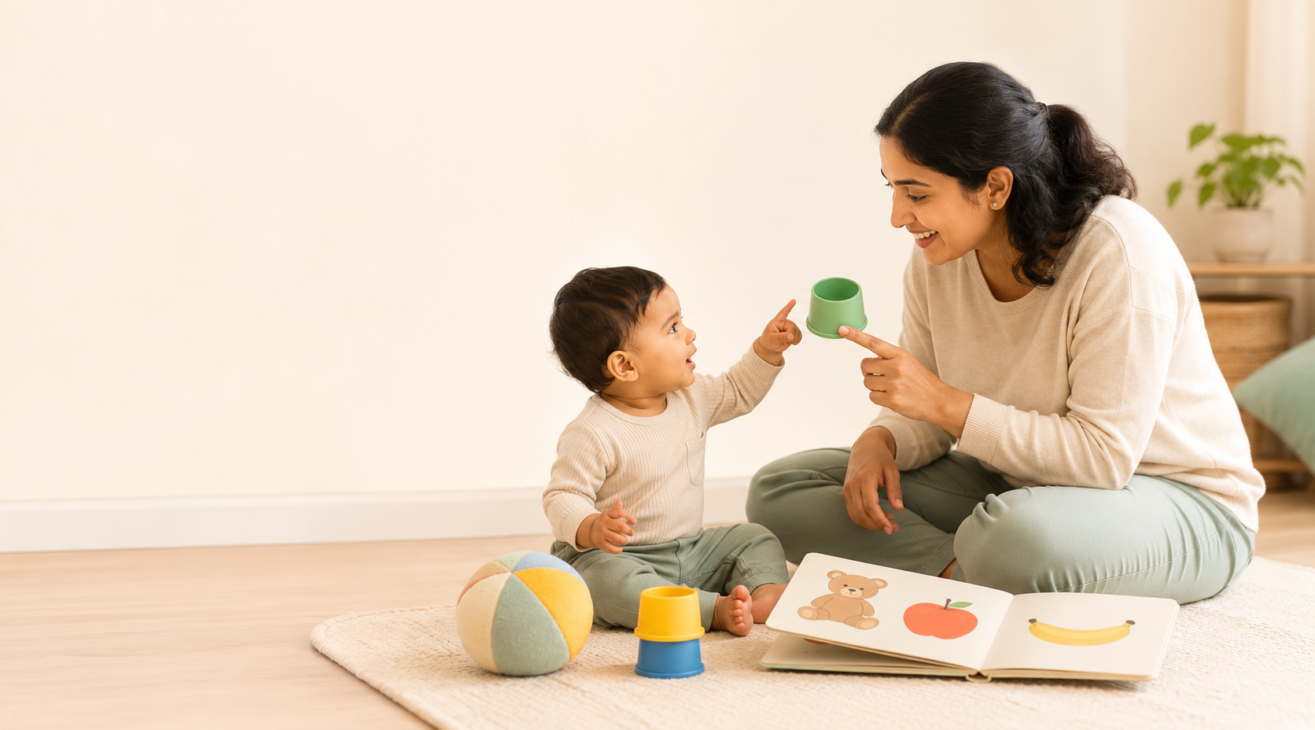
Start with the back-and-forth of communication. Notice what your child looks at, reaches for, points toward, or sounds excited about. Respond with a word, expression, gesture, or short phrase.
Example: Your child reaches toward a ball. You can say, “Ball! You want the ball. Here’s the ball!”
Listening & Understanding
Help words become meaningful by connecting them to real actions and objects. Use simple language during familiar routines such as getting dressed, eating, bathing, cleaning up, and going outside.
Example: “Shoes on.” “Open the door.” “Get the cup.” “Where is the dog?”
First Words
Practice short, useful words connected to things your child sees and enjoys often. Repetition works best when the word appears in a meaningful moment instead of being practiced in isolation.
Good first-word themes: family, food, pets, toys, vehicles, body parts, clothing, and everyday objects.
Vocabulary by Topic
Learning related words together can make vocabulary easier to organize. Banabooza topic collections can introduce words through familiar groups such as fruits, animals, transportation, family, foods, colors, toys, and household objects.
Action Words
Action words are especially easy to demonstrate during play. Try words such as “go,” “stop,” “eat,” “drink,” “jump,” “sit,” “open,” “close,” “wash,” and “push.”
Describing Words
Add simple words that describe what your child can see or feel: “big,” “little,” “hot,” “cold,” “soft,” “wet,” “fast,” “red,” or “round.” For younger children, use just one describing word at a time.
Position & Direction Words
Movement makes words like “up,” “down,” “in,” “out,” “on,” “off,” “under,” and “over” easier to understand. Use toys, blocks, cups, boxes, and your child’s own movements to make these words concrete.
Social & Functional Words
Some of the most useful early words help children participate in everyday life. Practice words and gestures such as “hi,” “bye,” “more,” “help,” “please,” “thank you,” “yes,” “no,” “mine,” “all done,” and “again.”
Questions & Conversation
Even before children answer with many words, parents can model simple conversational patterns. Ask an easy question, give your child time to react, and then respond naturally to their sound, gesture, look, or word.
Storytelling Language
Storytelling starts simply. Talk about what just happened: “We saw a dog. The dog ran. Then we came home.” As children grow, these tiny everyday stories can become longer descriptions and conversations.
Exact Words to Try With a 1-Year-Old
Short, repeatable language is usually easier to use during everyday activities. You can try phrases like these:
- “Ball. Big ball.”
- “Dog! Hi, dog.”
- “More banana?”
- “Up you go!”
- “Open the box.”
- “Car goes vroom!”
- “Drink water.”
- “Bye-bye, Daddy.”
- “Where’s your shoe?”
- “You found it!”
You do not need to ask your child to repeat every word. Say the word clearly, connect it to what is happening, and leave room for your child to respond in their own way.
Try This 5-Minute Activity
Pick one featured communication & first words activity from the child’s age page and try it for five minutes.
Example: The “Find and Say” Game
- Choose three familiar objects, such as a ball, cup, and shoe.
- Place them where your child can easily see them.
- Hold up one object and say its name slowly: “Ball.”
- Use it naturally: “Roll the ball!”
- Repeat the word a few times during play.
- Move to another object when your child loses interest.
The goal is not to get a correct answer. The goal is to make the word meaningful, familiar, and fun to hear.
Make It Easier
If your child is not interested in a structured activity, make the activity smaller. Use one object instead of three. Say one word instead of a full sentence. Point instead of asking a question. Practice during a routine your child already enjoys.
For example, instead of asking, “Can you tell me what this is?” simply hold up the cup and say, “Cup. Your cup. Drink from the cup.”
You can also use gestures, facial expressions, sounds, pointing, and choices. Communication is bigger than spoken words alone.
Best Banabooza Resources for Communication & First Words
1. First Words Learning Videos
Short videos that introduce one familiar word at a time with clear repetition. Great for pairing screen-based learning with a real object afterward.
2. Vocabulary by Topic Collections
Explore themed word groups such as animals, fruits, foods, transportation, family, pets, colors, and everyday objects.
3. First Words Picture Books
Choose sturdy picture books with large, clear images and only a few items per page. Point, name, pause, and let your child explore at their own pace.
4. Matching and Word Games
Simple Banabooza games can pair a spoken word with an image, object, sound, or action. Start with familiar vocabulary before introducing more choices.
5. Action Word Games
Turn words into movement with prompts such as “clap,” “wave,” “sit,” “stand,” “go,” “stop,” “push,” and “roll.”
6. Communication During Daily Routines
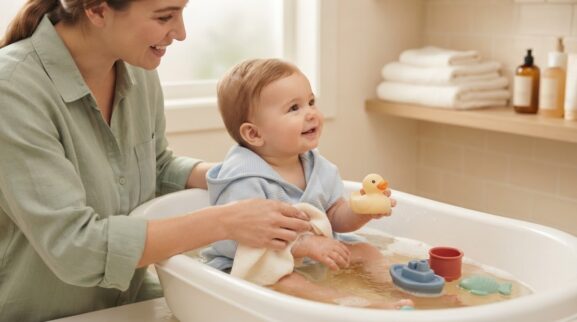
Use meals, bath time, dressing, diaper changes, cleanup, walks, and bedtime to repeat practical words your child hears every day.
7. Object and Picture Cards
Use simple cards showing familiar objects. Pick only two or three at a time and connect them to real objects whenever possible.
8. Parent-and-Child Music Classes
Music classes can provide playful opportunities to hear repeated words, copy actions, take turns, use gestures, and participate in familiar songs with a parent or caregiver.
9. Parent-and-Child Early Learning Classes
Look for local or online classes built around books, songs, movement, sensory play, or everyday vocabulary. Choose programs that welcome parent participation and playful interaction.
10. Pretend-Play Toys
Toy food, animals, vehicles, dolls, play kitchens, and simple household play sets can give parents easy opportunities to model names, actions, sounds, and short phrases.
Product Ideas That Support Communication Play
- Large picture-word board books
- Animal figures for naming and sound play
- Toy fruits and foods for everyday vocabulary
- Simple vehicle sets for words such as car, bus, go, stop, fast, and slow
- Stacking cups for in, out, up, down, big, and little
- Shape sorters for naming, choosing, putting in, and taking out
- Simple dolls or family figures for social words and pretend conversation
- Picture cards showing common objects, actions, and people
Printable Idea
One-page category map showing age → subcategory → activity ideas.
Parents can keep the map somewhere easy to see and quickly choose an activity based on their child’s age. For example:
- 1 Year → First Words → name three familiar objects during play.
- 1 Year → Action Words → practice “go” and “stop” with a toy car.
- 2 Years → Vocabulary by Topic → find five animal pictures together.
- 3 Years → Position Words → put a toy in, on, under, and beside a box.
- 4 Years → Questions & Conversation → talk about a favorite part of the day.
- 5 Years → Storytelling Language → tell a three-part story about something that happened.
What to Do Next
For a 1-year-old, start with First Words, Responsive Communication, Listening & Understanding, and Social & Functional Words. Choose one activity rather than trying several at once.
Once an activity feels familiar, add a related word. If your child enjoys rolling a ball while hearing “ball,” for example, you might later add “roll,” “go,” “big,” or “more.” This creates a natural path from one useful word into a wider vocabulary.
Related Communication & First Words Resources
- First Words for 1-Year-Olds
- Listening & Understanding Activities
- Responsive Communication Ideas for Parents
- Everyday Vocabulary by Topic
- Action Words Through Play
- Social & Functional Words
- Animal Words for Toddlers
- Food and Fruit Words for Toddlers
- Transportation Words for Toddlers
- Parent-and-Child Learning Classes
- Banabooza Learning Games
- First Words Books & Learning Toys
Keep communication playful, useful, and connected to real life. Follow what interests your child, repeat words naturally, and build from the small interactions your family already shares every day.