Action Words with a Toy Basket Talk-and-Play for 1-Year-Old Toddlers
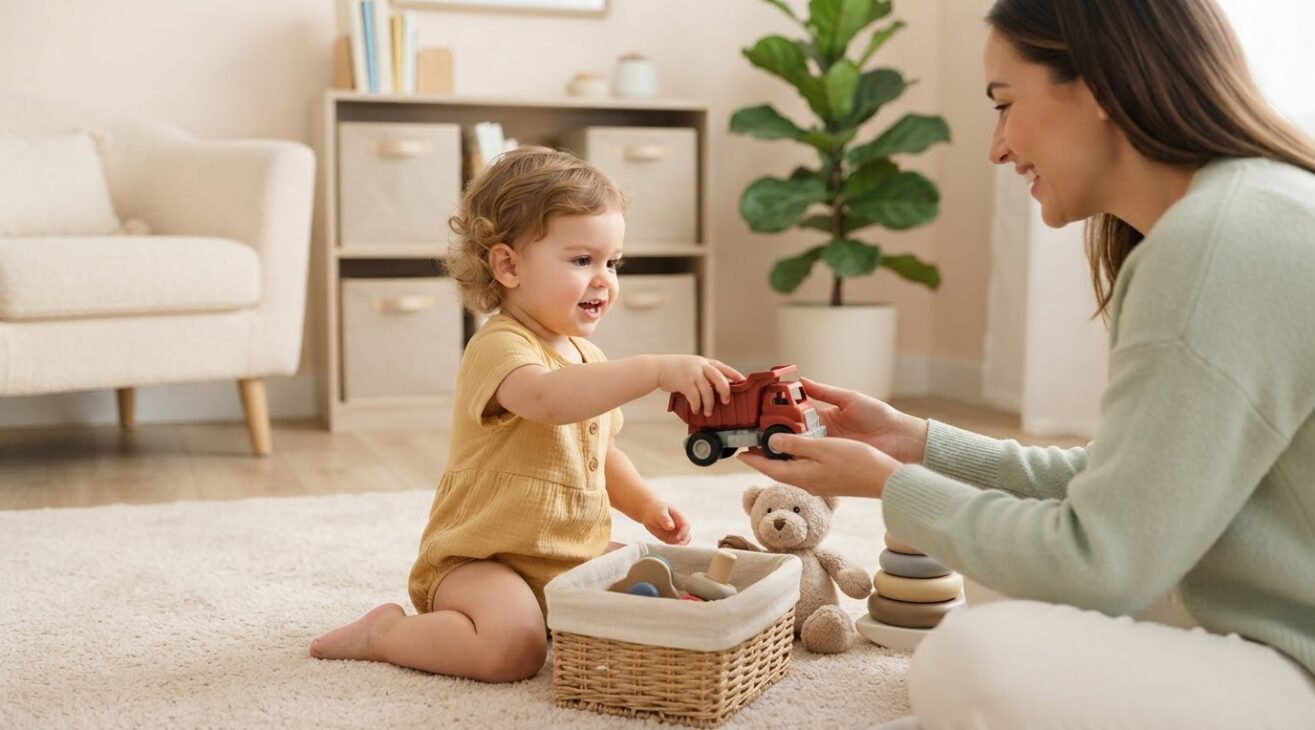
A practical way to explore action words with a toy basket talk-and-play for 1 year old toddlers is to connect the idea with something familiar your child can actually do or notice. This toy basket talk-and-play idea starts with something familiar and turns it into a few minutes of purposeful play. The adult models the idea, the child joins in however they can, and the activity ends before it starts to feel like work. Use the toy basket talk-and-play setting to practice action words: choose one or two useful words or short phrases, connect them to what your child can see or do, then pause for any look, gesture, sound, action, or word. Treat that as the starting idea, not a script you have to follow perfectly—adapt the pace, materials, and number of turns to your child’s interest.
Quick Activity
Think of this as a short back-and-forth experience. Use the toy basket talk-and-play setting to practice action words: choose one or two useful words or short phrases, connect them to what your child can see or do, then pause for any look, gesture, sound, action, or word. You provide the structure and simple language; your child can participate through looking, pointing, moving an object, copying an action, choosing, gesturing, or trying a word. The purpose is connecting action words with movements the child can see, do, and pretend, not finishing a set number of turns.
Related Resources
Looking for more ways to support action words beyond this activity? Explore Flashcards & Learning Cards for picture, word, and concept cards that make the skill easy to revisit in short, playful practice. For guided local or online learning opportunities, browse Language & Literacy to find language, literacy, communication, storytime, or early-reading classes and programs related to this skill.
What This Practices
Children get more useful practice when a learning idea appears in context. Here, the skill is attached to something visible, touchable, movable, tellable, or repeatable. That makes it easier for the adult to model connecting action words with movements the child can see, do, and pretend while keeping the interaction natural. The focus is not on speed or correctness; it is on giving your child a useful experience with action words that is easy to repeat.
What You Need
- one or two familiar objects or toys connected to the words you want to model
- two or three familiar, age-appropriate toys or pretend-play props
- your voice, body percussion, or one age-appropriate sound-making item
Safety note: For children under 3, choose only large, age-appropriate materials and supervise the entire activity.
How to Do It
- Choose one small part of the toy basket talk-and-play idea and decide on one or two useful words or short phrases connected to action words.
- Model the language while the object, action, person, or routine is visible. Keep your sentence short enough that the meaning is easy to connect with what is happening.
- Pause and give your child time to participate through looking, pointing, moving an object, copying an action, choosing, gesturing, or trying a word. Respond to what they actually do instead of immediately repeating the prompt.
- Repeat the same word or phrase in one more natural moment. Change the action or object slightly so the language stays meaningful rather than sounding drilled.
- Finish with a simple comment about what happened and move on while the interaction still feels enjoyable.
What to Say
Keep your language short and connected to what is happening. You do not need to use every phrase below; choose a few that sound natural in your family.
- “Time to sit.”
- “Clap hands.”
- “Open it.”
- “Push.”
- “Walk, walk.”
- “Wash hands.”
What to Notice
There is no single response you need to see for the activity to be worthwhile. Look for small signs that your child is engaged with the idea.
- If interest fades, stop and try again another time; short positive experiences are easier to repeat.
- Your child may show interest through pointing, copying, choosing, moving an item intentionally, using a gesture, or trying part of a word or action.
- The goal is participation and curiosity, not a perfect answer or finished product.
Make It Easier
Make the next turn easier before adding anything new. Use one clear example, one short phrase, and plenty of modeling. Pointing or moving an object can be the whole turn.
Try This Next
Once the toy basket talk-and-play idea feels familiar, keep the same basic structure but change one feature—location, object, order, role, or example. Add one second example or repeat the same skill during another familiar routine later in the day.
Use It in Everyday Life
The easiest way to keep learning useful is to let the same idea show up in ordinary moments. Try one of these simple extensions:
- When your child points, looks, moves, or vocalizes, treat it as communication and add a short word or phrase that matches the moment.
- Repeat the same useful language in books, play, and real life so the meaning stays connected across situations.
- Use one action words word or phrase during meals, dressing, cleanup, bath time, or another routine that already happens every day.
Keep Learning
This is one practical way to revisit action words with a toy basket talk-and-play for 1 year old toddlers through short, playful practice. Within Communication & First Words, related ideas to explore next include Listening & Understanding, Responsive Communication, and Vocabulary by Topic. You do not need to work on them all at once; choose the one that naturally connects with what your child enjoyed today. Follow your child’s interest, keep the tone warm and low-pressure, and stop while the activity still feels successful.