
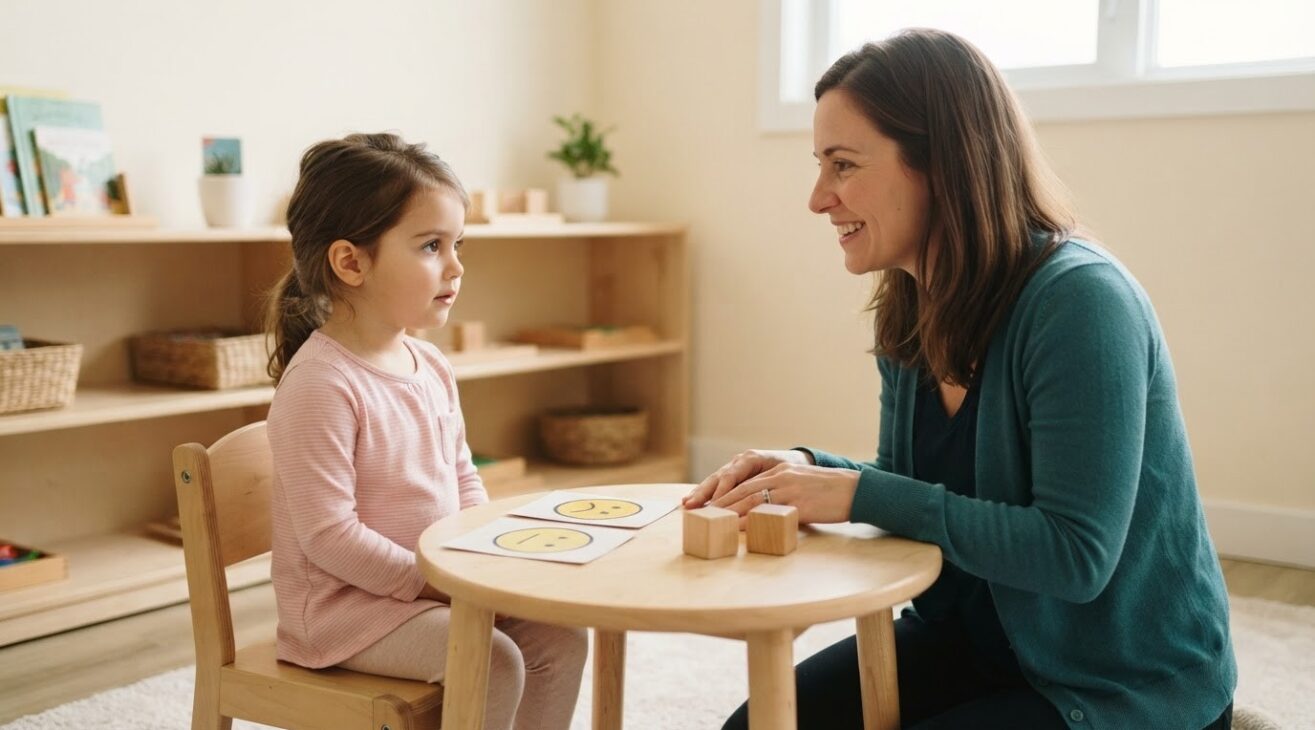
Social Problem Solving with a Feelings-and-Choices Talk for 4-Year-Old Preschoolers
You can practice social problem solving with a feelings-and-choices talk for 4 year old preschoolers in ordinary play; the key is to keep the experience short, clear, and connected to real meaning. The purpose of this feelings-and-choices talk activity is simple: make social problem solving visible, active, and enjoyable enough to revisit on another day. Use the feelings-and-choices talk idea to create one calm, realistic moment connected to social problem solving: model simple words or actions, acknowledge the social or emotional cue, and let your child participate without requiring a particular response. Treat that as the starting idea, not a script you have to follow perfectly—adapt the pace, materials, and number of turns to your child’s interest.
Quick Activity
Think of this as a short back-and-forth experience. Use the feelings-and-choices talk idea to create one calm, realistic moment connected to social problem solving: model simple words or actions, acknowledge the social or emotional cue, and let your child participate without requiring a particular response. You provide the structure and simple language; your child can participate through predicting, explaining, creating, sorting, building, drawing, moving, comparing, or retelling. The purpose is seeing more than one possible response to a small everyday social problem, not finishing a set number of turns.
Related Resources
Looking for more ways to support social problem solving beyond this activity? Explore Pretend Play for pretend-play materials that extend the learning idea through imagination, role-play, language, and familiar scenarios. For guided local or online learning opportunities, browse Early Learning & Preschool to find early-learning and preschool classes, programs, activities, businesses, or events where children can get guided practice with this learning area.
What This Practices
The value is not in completing the activity perfectly. It is in giving your child repeated chances to notice the same idea in a meaningful setting. Each turn lets you model seeing more than one possible response to a small everyday social problem, then pause long enough for your child to respond in their own way. The focus is not on speed or correctness; it is on giving your child a useful experience with social problem solving that is easy to repeat.
What You Need
- large paper and jumbo age-appropriate drawing or art materials
How to Do It
- Use the feelings-and-choices talk idea to create one familiar, low-pressure situation connected to social problem solving.
- Describe what is happening before asking a question. Name the feeling, social cue, relationship, or problem in calm, concrete language.
- Model one useful phrase or action, then give space for predicting, explaining, creating, sorting, building, drawing, moving, comparing, or retelling. Watching quietly can be a valid first step.
- Replay the moment once with a small change so your child sees another possible response or outcome.
- End with connection rather than correction. Notice effort, a feeling, a choice, a kind action, or a moment of trying again.
What to Say
Keep your language short and connected to what is happening. You do not need to use every phrase below; choose a few that sound natural in your family.
- “What would be fair?”
- “What happened?”
- “What could we try?”
- “Can we make room?”
- “Let’s use words.”
- “Is there another way?”
What to Notice
There is no single response you need to see for the activity to be worthwhile. Look for small signs that your child is engaged with the idea.
- Watching the modeled language or staying near you during the interaction can be meaningful participation, especially before a child is ready to use the words.
- If interest fades, stop and try again another time; short positive experiences are easier to repeat.
- Your child may show interest through making a prediction, explaining what changed, planning a step, using a strategy, or connecting the idea to something familiar.
Make It Easier
If the feelings-and-choices talk setup feels busy, remove extra choices and return to one clear example. Do the first example together and keep the materials visually simple. Give one clue instead of several instructions.
Try This Next
Keep the successful part the same and change only one thing. Add one manageable challenge: a new material, another category, a longer sequence, or a chance to explain why.
Use It in Everyday Life
The easiest way to keep learning useful is to let the same idea show up in ordinary moments. Try one of these simple extensions:
- Use toys and stories to replay a difficult or interesting social moment later when everyone is calm.
- Model the exact words you hope your child can eventually use while accepting gestures, partial attempts, and silence.
- Name social problem solving moments when they happen naturally, without requiring your child to explain or perform a particular response.
Keep Learning
You can come back to social problem solving with a feelings-and-choices talk for 4 year old preschoolers whenever the same idea appears naturally in play or a daily routine. Within Social, Emotional & Relationships, related ideas to explore next include Separation & Reunion Routines, Calm-Down & Regulation Routines, and Empathy & Kindness. You do not need to work on them all at once; choose the one that naturally connects with what your child enjoyed today. Follow your child’s interest, keep the tone warm and low-pressure, and stop while the activity still feels successful.