Ball Play with a Move Like an Animal for 4-Year-Old Preschoolers
You can practice ball play with a move like an animal for 4 year old preschoolers in ordinary play; the key is to keep the experience short, clear, and connected to real meaning. The goal is to make ball play concrete, playful, and easy to repeat. This move like an animal setup gives you a practical way to do that with a 4-year-old preschooler using everyday interaction. Use the move like an animal idea as a short movement game for ball play: clear a safe space, model one simple action, and let your child explore the movement in a way that matches their current mobility. Treat that as the starting idea, not a script you have to follow perfectly—adapt the pace, materials, and number of turns to your child’s interest.
Quick Activity
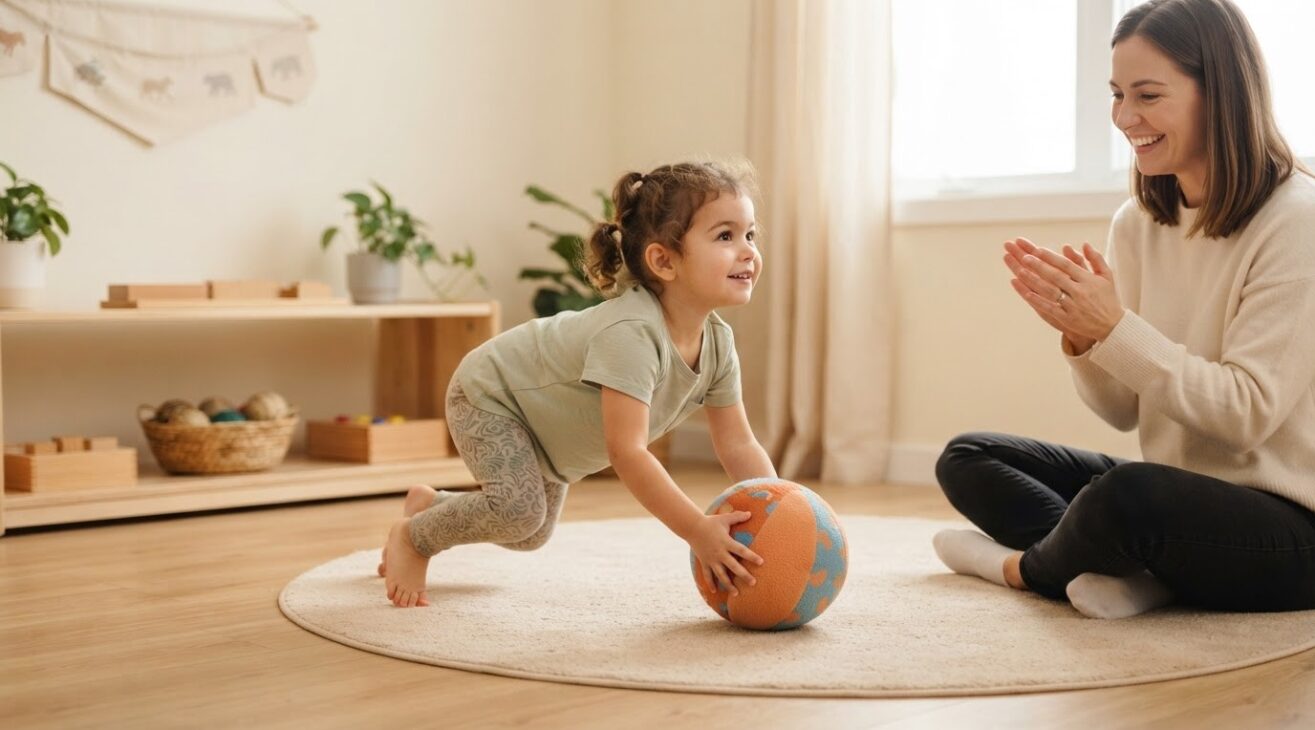
Use the move like an animal idea as a tiny play invitation rather than a test. Use the move like an animal idea as a short movement game for ball play: clear a safe space, model one simple action, and let your child explore the movement in a way that matches their current mobility. Show the first turn yourself, pause, and let your child’s response decide whether you repeat, simplify, or add one small variation. This supports rolling, carrying, tossing, catching, or kicking a soft ball in age-appropriate ways.
Related Resources
Looking for more ways to support ball play beyond this activity? Explore Movement & Active Play for active-play materials that support the skill through movement, balance, coordination, and playful physical practice. For guided local or online learning opportunities, browse Sports & Gymnastics to find sports, gymnastics, and movement programs that provide structured, age-appropriate physical practice.
What This Practices
The value is not in completing the activity perfectly. It is in giving your child repeated chances to notice the same idea in a meaningful setting. Each turn lets you model rolling, carrying, tossing, catching, or kicking a soft ball in age-appropriate ways, then pause long enough for your child to respond in their own way. The focus is not on speed or correctness; it is on giving your child a useful experience with ball play that is easy to repeat.
What You Need
- a clear, safe movement space
- a few large familiar objects, pictures, or household items
Safety note: Keep the movement area clear, stable, and appropriate for the child’s current mobility.
How to Do It
- Clear a safe space for the move like an animal activity and remove obstacles that are not part of the game.
- Model one movement connected to ball play. Show where it starts and ends, then keep the directions brief.
- Let your child move in a way that fits their current ability. Participation can include predicting, explaining, creating, sorting, building, drawing, moving, comparing, or retelling; stay close enough to support balance or transitions when needed.
- Repeat the movement and vary one feature such as direction, speed, distance, level, target, or starting position.
- Finish with a slower movement or a short pause so the activity has a calm, clear ending.
What to Say
Keep your language short and connected to what is happening. You do not need to use every phrase below; choose a few that sound natural in your family.
- “Stop.”
- “Your turn to move.”
- “Slow steps.”
- “Reach up.”
- “Let’s try it one more way.”
- “Ready, go.”
What to Notice
There is no single response you need to see for the activity to be worthwhile. Look for small signs that your child is engaged with the idea.
- Your child may show interest through making a prediction, explaining what changed, planning a step, using a strategy, or connecting the idea to something familiar.
- The goal is participation and curiosity, not a perfect answer or finished product.
- If interest fades, stop and try again another time; short positive experiences are easier to repeat.
Make It Easier
Shorten the activity, model more, and ask for less. Do the first example together and keep the materials visually simple. Give one clue instead of several instructions.
Try This Next
Once the move like an animal idea feels familiar, keep the same basic structure but change one feature—location, object, order, role, or example. Add one manageable challenge: a new material, another category, a longer sequence, or a chance to explain why.
Use It in Everyday Life
The easiest way to keep learning useful is to let the same idea show up in ordinary moments. Try one of these simple extensions:
- Repeat favorite movement games rather than constantly increasing difficulty.
- Use familiar rooms, hallways, yards, or playground spaces for short movement challenges instead of needing special equipment.
- Pair movement words with ball play: stop, go, reach, roll, step, crawl, kick, turn, or stretch when appropriate.
Keep Learning
Think of ball play with a move like an animal for 4 year old preschoolers as something to revisit in small moments rather than something to master in one sitting. Within Gross Motor & Movement, related ideas to explore next include Supervised Floor-Time Interaction, Animal Movements, and Dance & Freeze. You do not need to work on them all at once; choose the one that naturally connects with what your child enjoyed today. Follow your child’s interest, keep the tone warm and low-pressure, and stop while the activity still feels successful.