Help your baby or toddler discover new words through everyday activities, play, and simple conversations! At Banabooza, we make early language learning fun and accessible for little learners and their families.
Whether your baby is beginning to recognize familiar words or your toddler is learning to express their needs, describe objects, and communicate with others, exploring different word categories can help build vocabulary and communication skills.
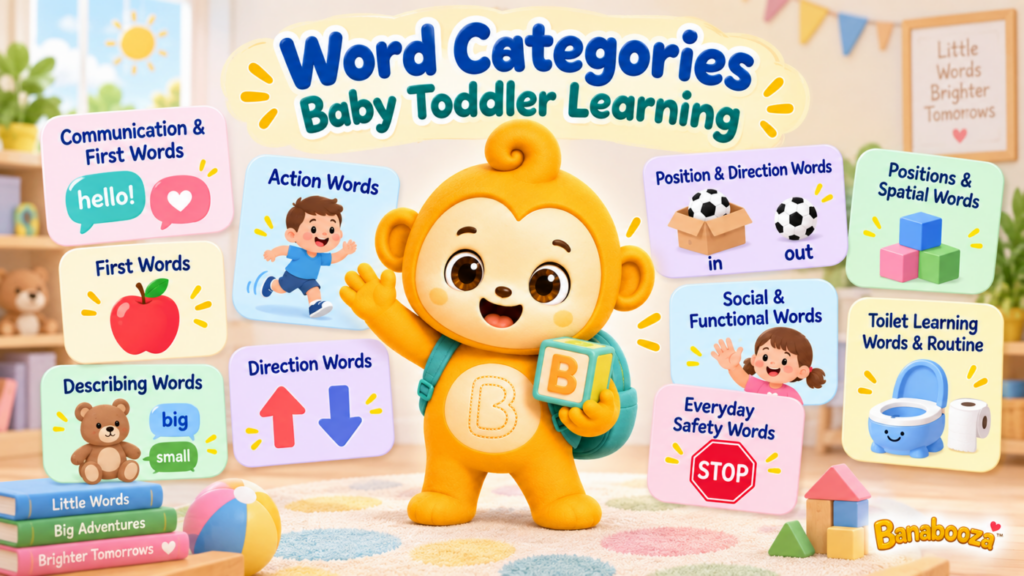
Choose a word category below to explore learning activities, word examples, and educational resources designed for babies and toddlers. Each category includes related learning posts to help you practice new words with your child at their own pace.
Explore Baby & Toddler Word Categories:
Communication & First Words
Help your baby or toddler develop early communication skills through sounds, gestures, listening, and simple words. Explore activities that encourage your child to understand language, express their needs, and begin communicating with others.
Learning examples: Mama, dada, hi, bye, more, and help.
First Words
Discover simple and familiar words that babies and toddlers can learn through everyday experiences. Explore individual word-learning posts featuring common objects, animals, foods, family members, and other familiar things.
Learning examples: Ball, cup, dog, cat, apple, and baby.
Action Words
Teach your toddler words that describe everyday movements and activities. Action words help children understand what people and objects do while learning to express their own actions through play and daily routines.
Learning examples: Eat, drink, jump, run, walk, sleep, and play.
Describing Words
Help your child learn words that describe the size, color, appearance, temperature, and other characteristics of familiar objects. Describing words give toddlers more ways to communicate what they see, feel, and experience.
Learning examples: Big, small, soft, hot, cold, wet, and dry.
Direction Words
Introduce simple words that describe movement and direction. These words help toddlers understand everyday instructions and describe where they or other objects are moving.
Learning examples: Up, down, forward, backward, left, and right.
Position & Direction Words
Explore words that help children understand both where objects are located and how they move. Use toys, books, and everyday activities to introduce simple position and direction concepts.
Learning examples: In, out, on, off, over, under, up, and down.
Positions & Spatial Words
Help your toddler understand how objects relate to one another in space. Explore vocabulary that describes locations, distances, and positions through building blocks, sorting activities, and playful exploration.
Learning examples: Inside, outside, beside, between, behind, near, and far.
Social & Functional Words
Support your child’s ability to interact with others, communicate their needs, and participate in everyday social situations. Explore useful words and expressions for greetings, requests, sharing, and simple conversations.
Learning examples: Hello, goodbye, please, thank you, yes, no, and more.
Everyday Safety Words
Introduce simple safety-related vocabulary to help your toddler become familiar with important words used during daily activities. Practice these words through calm explanations, supervised play, and everyday routines.
Learning examples: Stop, wait, hot, careful, hold, and help.
Toilet Learning Words & Routine
Help your toddler become familiar with words and expressions associated with using the toilet, washing hands, and developing everyday independence. Explore simple vocabulary and activities that support positive, pressure-free toilet learning.
Learning examples: Potty, toilet, pee, poop, wipe, flush, and wash.
How to Help Your Baby or Toddler Learn New Words
You don’t need special equipment or long lessons to help your child develop vocabulary. Everyday moments offer opportunities to introduce new words and practice familiar ones.
- Choose one category that matches your child’s current interests and communication skills.
- Say words clearly while showing your child the corresponding object, movement, or action.
- Repeat new words naturally during meals, playtime, bath time, and other familiar routines.
- Give your child time to respond through sounds, gestures, pointing, or speech.
- Celebrate their efforts and follow their interests without pressuring them to repeat words.
For example, when playing with a ball, you might say, “Ball! Big ball! Roll the ball!” This simple interaction introduces an object word, a describing word, and an action word in a meaningful context.
Make Every Day a Learning Adventure with Banabooza!
Every child develops communication and language skills at their own pace. Whether your little learner is listening to their first words, pointing to familiar objects, or beginning to combine words into short sentences, there are many ways to make learning part of your family’s daily life.
Explore the word categories above to discover related learning posts, simple vocabulary activities, and new ideas for helping your baby or toddler build communication skills.
Start with one category, explore a few new words, and enjoy learning together!