
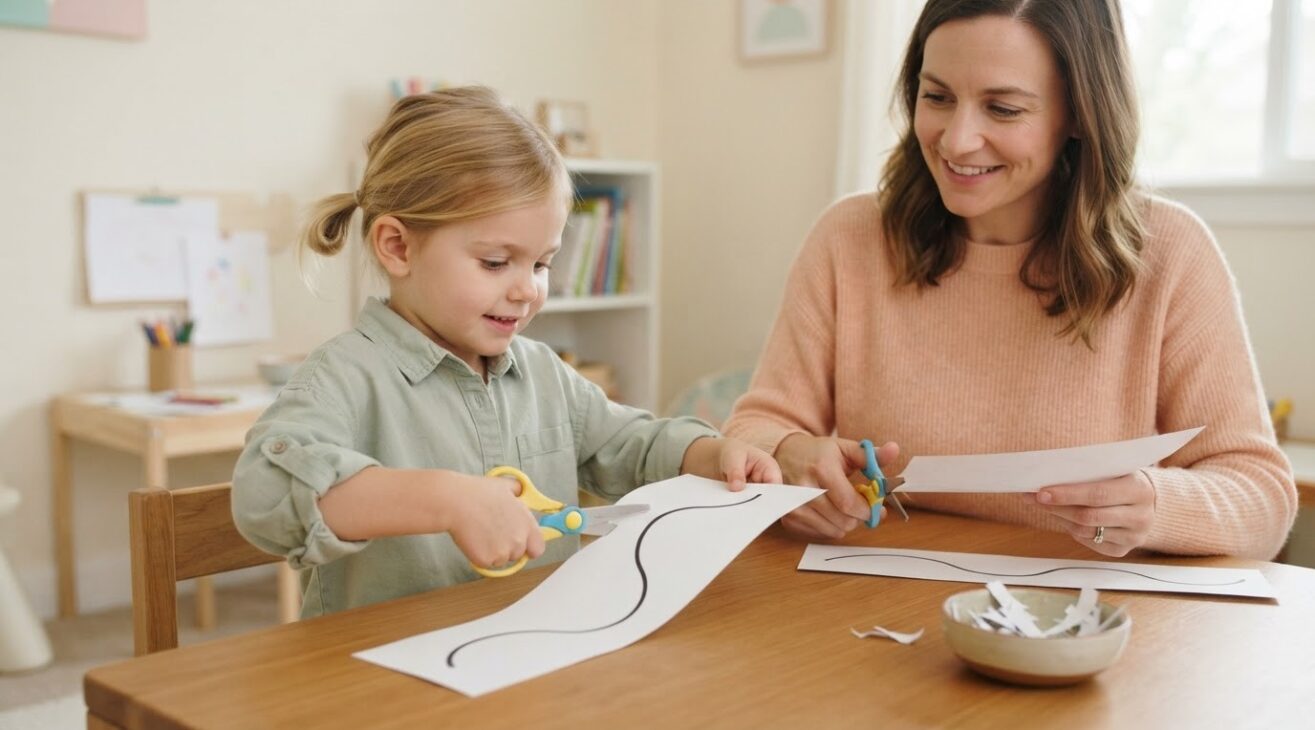
Cutting & Paper Skills with a Parent-Child Motor Challenge for 4-Year-Old Preschoolers
One easy starting point for cutting & paper skills with a parent-child motor challenge for 4 year old preschoolers is a familiar activity that gives your child time to look, move, listen, choose, or respond. The parent-child motor challenge idea turns cutting & paper skills into something your child can see, do, hear, move, or talk about instead of something that feels like a lesson. You can try it in 6-10 minutes and stop while your child is still interested. Set up the parent-child motor challenge idea as a short supervised hands-on activity for cutting & paper skills, using age-appropriate materials so your child can repeat the key hand, eye, or sensory action at a comfortable pace. Treat that as the starting idea, not a script you have to follow perfectly—adapt the pace, materials, and number of turns to your child’s interest.
Quick Activity
For this version, keep only what you need for one clear example. Set up the parent-child motor challenge idea as a short supervised hands-on activity for cutting & paper skills, using age-appropriate materials so your child can repeat the key hand, eye, or sensory action at a comfortable pace. Spend roughly 6-10 minutes noticing, trying, and repeating. The activity is designed to support opening, closing, guiding, and positioning child-safe scissors with close adult supervision without pressuring your child to perform.
What This Practices
Children get more useful practice when a learning idea appears in context. Here, the skill is attached to something visible, touchable, movable, tellable, or repeatable. That makes it easier for the adult to model opening, closing, guiding, and positioning child-safe scissors with close adult supervision while keeping the interaction natural. The focus is not on speed or correctness; it is on giving your child a useful experience with cutting & paper skills that is easy to repeat.
What You Need
- paper and child-safe scissors appropriate for the child’s age
Safety note: Use child-safe scissors intended for the child’s age and stay close enough to guide safe use.
How to Do It
- Arrange the parent-child motor challenge materials so your child can reach them comfortably and the main action for cutting & paper skills is easy to see.
- Demonstrate the movement slowly—reach, grasp, place, press, draw, transfer, squeeze, guide, or manipulate—without turning it into a correction exercise.
- Let your child try in their own way. Participation can include predicting, explaining, creating, sorting, building, drawing, moving, comparing, or retelling; help only enough to keep the materials safe and usable.
- Repeat the same hand or sensory action several times, then make one small change such as position, texture, direction, size, or target.
- Stop when hands look tired or interest drops. End with a simple observation about what your child did rather than how neatly it looked.
What to Say
Keep your language short and connected to what is happening. You do not need to use every phrase below; choose a few that sound natural in your family.
- “Use two hands.”
- “Try a slow movement.”
- “You changed how it looks or feels.”
- “Pick it up.”
- “Place it here.”
- “Press gently.”
What to Notice
There is no single response you need to see for the activity to be worthwhile. Look for small signs that your child is engaged with the idea.
- The goal is participation and curiosity, not a perfect answer or finished product.
- If interest fades, stop and try again another time; short positive experiences are easier to repeat.
- Your child may show interest through making a prediction, explaining what changed, planning a step, using a strategy, or connecting the idea to something familiar.
Make It Easier
Shorten the activity, model more, and ask for less. Do the first example together and keep the materials visually simple. Give one clue instead of several instructions.
Try This Next
Use the same skill in a second everyday context so your child sees that cutting & paper skills can show up in more than one place. Add one manageable challenge: a new material, another category, a longer sequence, or a chance to explain why.
Use It in Everyday Life
The easiest way to keep learning useful is to let the same idea show up in ordinary moments. Try one of these simple extensions:
- Keep sessions short and stop before hands are tired or frustration takes over.
- Invite participation in safe everyday tasks such as placing, carrying, drawing, pouring, turning pages, or putting items away.
- Repeat the hand or sensory action used in cutting & paper skills with different safe materials so practice stays fresh.
Related Resources
Looking for more ways to support cutting & paper skills beyond this activity? Explore Arts & Music for art and music materials that extend the skill through creative, sensory, rhythmic, and hands-on activities. For guided local or online learning opportunities, browse Art & Creativity to find art classes, creative workshops, studios, lessons, or events where children can explore the skill with guidance.
Keep Learning
Think of cutting & paper skills with a parent-child motor challenge for 4 year old preschoolers as something to revisit in small moments rather than something to master in one sitting. Within Fine Motor & Sensory, related ideas to explore next include Drawing & Scribbling, Posting & Pegging, and Scooping & Pouring. You do not need to work on them all at once; choose the one that naturally connects with what your child enjoyed today. Follow your child’s interest, keep the tone warm and low-pressure, and stop while the activity still feels successful.